
The coaching question behind the question
We were discussing a team member whose performance had been a concern for a long time. The director had seen the pattern early. The employee was not delivering consistently, but there were personal difficulties in the background and she wanted to give him time.
She did not lack standards. She could see the gap clearly. What she struggled with was acting on what she already knew.
“I didn’t want to come across as unsupportive,” she told me.
That sentence carried the real coaching question. It was not simply whether the employee should stay. It was whether support had quietly become avoidance.
Empathy should inform judgement. It should not replace judgement.
For confidentiality, this is a composite and anonymised account. Names and non-essential details have been changed while preserving the leadership dilemma.
When care for one person creates a bill for everyone else
The employee had remained in role for almost two years despite sustained underperformance. Over time, the director began compensating for the gap herself. Work followed her home. Evenings that should have belonged to recovery or family became catch-up time.
This is one of the least visible costs of tolerated underperformance. The formal performance data may show one person below standard, but the operational cost spreads through the system.
The leader takes on additional work. Colleagues absorb tasks. Strong performers begin to notice that contribution and consequence are no longer aligned. Some become resentful. Others quietly reduce discretionary effort because the standard appears negotiable.
The problem therefore stops being a single employee issue. It becomes a question of fairness, workload distribution and leadership credibility.
Leadership test
Who is paying the hidden cost of the performance problem you are postponing?
“Isn’t 50% of someone better than nobody?”
There is a practical argument leaders often make in this situation: replacing someone takes time. Recruitment may take months. A weak performer who contributes something can appear better than an empty seat.
Sometimes that is rational. But the arithmetic is usually too narrow.
The choice is rarely 50% versus 0%.
A more honest equation looks something like this:
- the employee’s partial contribution,
- minus the manager’s compensating effort,
- minus work shifted to stronger colleagues,
- minus rework and quality risk,
- minus the morale cost of perceived unfairness,
- minus the organisational signal that sustained underperformance is tolerable.
When those costs are included, 50% can become much less than 50%.
A tolerated poor performer rarely costs only their own missing performance.
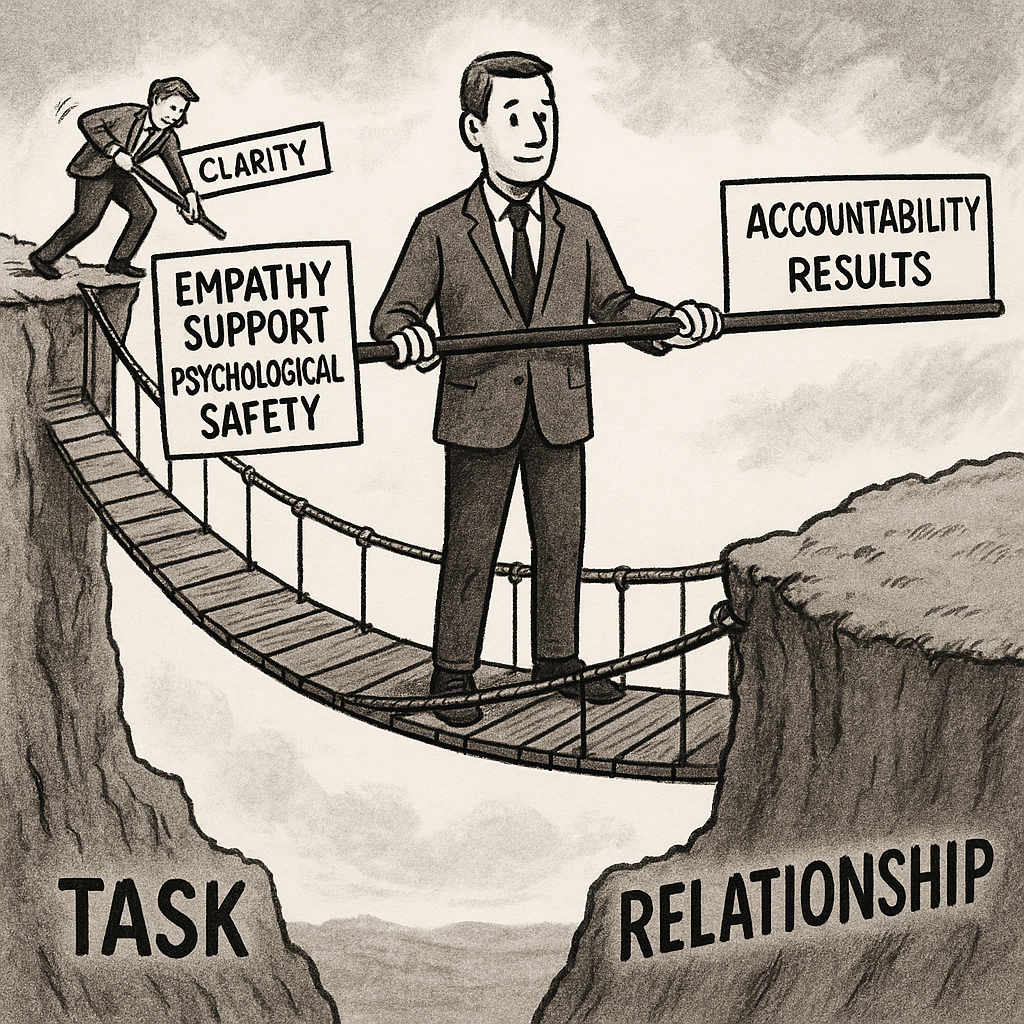
The leadership tension: task and relationship
I use a Task and Relationship Leadership Assessment as a coaching reflection tool. It is not presented here as a validated psychometric measure. It asks leaders to examine two dimensions that are easy to discuss separately but difficult to hold together in practice.
Task orientation concerns execution: clear goals, resources, accountability, deadlines, obstacle removal, quality and follow-through.
Relationship orientation concerns the human system: trust, listening, development, feedback, inclusion, confidence and teamwork.
The point is not to choose one over the other. The useful question is what happens when a leader over-relies on one dimension and neglects the other.
- Low task / High relationship
- Support is strong, but accountability can soften.
- High task / High relationship
- Clear expectations and human connection support one another, adapted to context.
- Low task / Low relationship
- Direction and connection are both weak.
- High task / Low relationship
- Results can come at the cost of trust and development.
My client was not “too relational” in every aspect of her leadership. The issue was more specific. In this case, she had allowed care for one person to weaken the task side of the contract: standards, consequences and shared accountability.
That distinction matters because empathy is not the problem. Empathy is information. It helps a leader understand context, human impact and what support may be appropriate. The leadership failure begins when understanding becomes exemption without a deliberate decision about the consequences.
Goleman’s six styles: empathy is not a single leadership style
Daniel Goleman’s 2000 Harvard Business Review article, Leadership That Gets Results, described six leadership styles associated with different emotional intelligence competencies: coercive, authoritative, affiliative, democratic, pacesetting and coaching.
The lasting value of the model is not the labels themselves. It is the argument that effective leaders use a repertoire rather than a single preferred style. They shift according to the situation.
That matters in cases like this one. A leader who naturally values affiliation, harmony and coaching may stay in those modes long after the situation requires clearer direction, firmer standards or a consequence.
Likewise, a leader who lives permanently in pacesetting or coercive mode may get short-term compliance while damaging learning, trust and ownership.
Maturity is not becoming more task-focused or more relationship-focused. It is developing range, then choosing deliberately.
The emotional part: what are you avoiding?
Susan David’s work on emotional agility adds another useful lens. In her 2016 Harvard Business Review article, 3 Ways to Better Understand Your Emotions, she emphasises the importance of identifying emotions accurately rather than being driven by a vague emotional reaction.
In a leadership situation like this, “I am being empathetic” may not describe the whole emotional picture. Underneath it might be anxiety about conflict, fear of being unfair, guilt about someone’s personal situation, discomfort with disappointing another person, or the desire to preserve an identity as a caring leader.
Naming that more precisely changes the decision.
If I am avoiding a conversation because I value compassion, that is one thing. If I am avoiding it because confrontation makes me uncomfortable, that is another. The behaviour may look identical from the outside, but the leadership work is different.
A better question
What is my empathy helping me understand, and what is my discomfort causing me to avoid?
The turning point: empathy with a boundary
The turning point came when HR asked the director to raise the employee’s performance rating. She had already concluded that the lower rating was justified.
This time, she did not absorb the tension.
She pushed back calmly and made the ownership explicit: if HR wanted a different performance judgement, they would also need to accept responsibility for the consequences of that decision.
The response surprised her. The case moved toward formal performance management rather than another cycle of quiet accommodation.
What stayed with me was not the procedural outcome. It was her emotional response afterward.
“I’m comfortable with pushing back,” she said. “I did the right thing.”
She had not become harder. She had become clearer.
The shift was from carrying the problem personally to placing accountability where it belonged.
What balanced leadership looks like in practice
- Acknowledge context without erasing standards. Personal difficulty can change the support offered, the pace of a process or the form of accommodation. It does not automatically remove performance expectations.
- Make support explicit and time-bound. Define what help is being offered, what improvement is expected and by when.
- Track the system cost. Ask what extra work the manager and colleagues are absorbing while the situation continues.
- Protect fairness as well as compassion. High performers also deserve empathy. So does the leader whose evenings are disappearing into compensating work.
- Escalate responsibility cleanly. If HR, a senior leader or another stakeholder proposes a different decision, agree the evidence, decision rights, support and resulting performance risk. The manager still has responsibilities within that process.
- Do not wait for emotional certainty. Difficult people decisions rarely feel perfectly clean. The standard is sufficient evidence, a fair process and values-consistent action.
Leadership reflection
Compassion and accountability are partners.
- Who on your team is receiving repeated understanding without enough accountability?
- What work are you carrying because you have delayed a performance decision?
- What are your strongest performers learning from what you tolerate?
- Are you protecting someone from a fair consequence, or supporting them through it?
- What would a high-task, high-relationship response look like now?
- What is your empathy causing you to avoid?
Good leadership is not a choice between people and performance.
People deserve dignity, context, support and fair treatment. Teams also deserve standards, clarity, equitable workload and leaders who act when performance consistently falls short.
Empathy tells us to see the person. Accountability reminds us to see everyone else too.
References and further reading
- Goleman, D. (2000). Leadership That Gets Results. Harvard Business Review, March–April.
- David, S. (2016). 3 Ways to Better Understand Your Emotions. Harvard Business Review, 10 November.
- Task and Relationship Leadership Assessment. Internal coaching reflection resource; not presented as a validated psychometric assessment.